

Folding the rear seat
The rear seatbacks can be folded to facilitate carrying long items or to increase the luggage capacity of the vehicle.
Folded Seatback
Do not sit on folded down seatbacks. The purpose of the fold-down rear seatbacks is to allow you to carry longer objects that could not otherwise be accommodated.
-
Never allow a passenger to sit on top of the folded down seatback whilst the car is moving. This is not a proper seating position since the seat has important crash protection features and seat belts are not available in this seat configuration.
-
To reduce the risk of injury caused by sliding cargo within the passenger compartment of the vehicle, objects carried on the folded down seatback should not extend higher than the top of the front seats.
-
Insert the rear seat belt buckle in the pocket between the rear seatback and cushion, and insert the rear seat belt into the two holes located on both sides.
-
Set the front seatback to the upright position and if necessary, slide the front seat forward.
-
Lower the rear headrests to the lowest position.
-
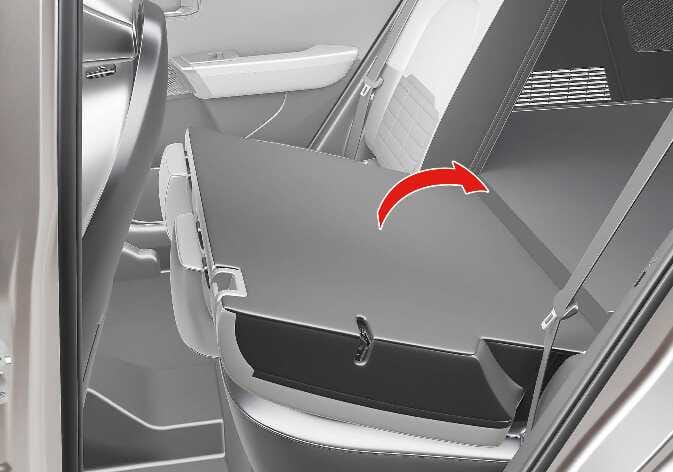
Pull on the seatback folding lever (1), then fold the seat toward the front of the vehicle.
Figure 1. Type A  N_SP3i26_D06_025_1_E
Figure 2. Type B  N_SP3i25_D06_003_IR
 -
To use the rear seat, lift and pull the seatback backward and be careful not to be located the seat belt between the rear seat and vehicle body. Pull the seatback firmly until it clicks into place.
Make sure the seatback is locked in place. When you return the seatback to its upright position, always be sure it has locked into position by pushing on the top of the seatback. For type A, If you can not see the red line at the bottom of folding lever, it means the seatback is locked completely.
-
Return the rear seat belt to the proper position.
-
When the seatback is completely installed, check the seatback folding lever again.
 N_SP3i25_D06_024_IR
-
Avoid excessive force when unfolding rear seat back.
-
Unfolding the seat with excessive force may lead to lock seat back in 2nd step. This is natural phenomenaon and adjust to the desired position if necessary. (applied to type 'A' only).
-
Never attempt to adjust whilst the vehicle is moving or the rear seat is occupied as the seat may suddenly move and cause the passenger on the seat to be injured.
-
The purpose of the fold-down rear seatbacks is to allow you to carry longer objects that could not be accommodated in the cargo area. Never allow passengers to sit on top of the folded down seatback whilst the vehicle is moving. This is not a proper seating position and no seat belts are available for use. This could result in serious injury or death in case of an accident or sudden stop. Objects carried on the folded down seatback should not extend higher than the top of the front seatbacks. This could allow cargo to slide forward and cause injury or damage during sudden stops.
-
Do not fold the rear seats, if passengers, pets or luggage are in the rear seats. It may cause injury or damage to passengers, pets or luggage.
-
When you return the seatback to its upright position, hold the seatback and return it slowly. If the seatback is returned without holding it, the back of the seat could spring forward resulting in injury caused by being struck by the seatback.
-
Cargo should always be secured to prevent it from being thrown about the vehicle in a collision and causing injury to the vehicle occupants. Do not place objects in the rear seats, since they cannot be properly secured and may hit the front seat occupants in a collision.
-
Make sure the vehicle is in OFF position, the Automatic Transmission/Intelligent Variable Transmission is in P (Park) or the Manual Transmission/Intelligent Manual Transmission is in R (Reverse) or 1st, and the parking brake is securely applied whenever loading or unloading cargo. Failure to take these steps may allow the vehicle to move if the shift lever is inadvertently moved to another position.
-
Never attempt to adjust whilst the vehicle is moving or the rear seat is occupied as the seat may suddenly move and cause the passenger on the seat to be injured.